Each year, colleges throughout the United States mark Valentine’s Day with the commemoration of Sex Week. Sex Week is a carnivalesque educational event, combining a how-to-guide to sexual pleasure with events celebrating sexual liberation. Sex Week functions as a kind of secularized liturgy, in which each year we both remember and celebrate the gift of sexual liberation—the freedom to do what and who we want with our bodies.
Topics: love, dating, hookup culture, Sex Week, Valentine's Day, romance, sex
Relocating is different from moving. This was one of the first things my husband, daughter, and I learned when transplanting ourselves, our stuff, and our lives from one mid-western city to another. Sure, both involve packing (and unpacking), finding a new place to store the Crock Pot, and identifying a good route for walking the dog. But relocation, because it involves moving across the country rather than just across the street, involves a much bigger transition. Starting over in a new community, new schools, and new jobs, involves transitioning one’s whole life. For this reason it is an entirely different enterprise and poses unique challenges. One challenge I had not fully anticipated was making new friends.
Topics: C.S. Lewis, love, friendship, vulnerability
The greatest joy of my ministry as a middle-school religion teacher is seeing the faces of my students. Sixty-eight of them pass through my classroom each school day, every one of them a reminder that my work is primarily for another. Despite the multitudinous challenges they present, my students have taught me the truth about service. The joy which comes from working first and foremost for the good of someone other than myself has astounded me, concretizing for me the truth that ministry is life-giving because it is, and only insofar as we receive it as, a face-to-face encounter with Christ.
Topics: Eucharistic Adoration, love, teaching, ministry
Editorial Note: This post is an excerpt from a presentation entitled “What’s Really Real? On Catholic Education and the Eucharist” presented by the author to Catholic school teachers of the Diocese of Fort Wayne–South Bend.
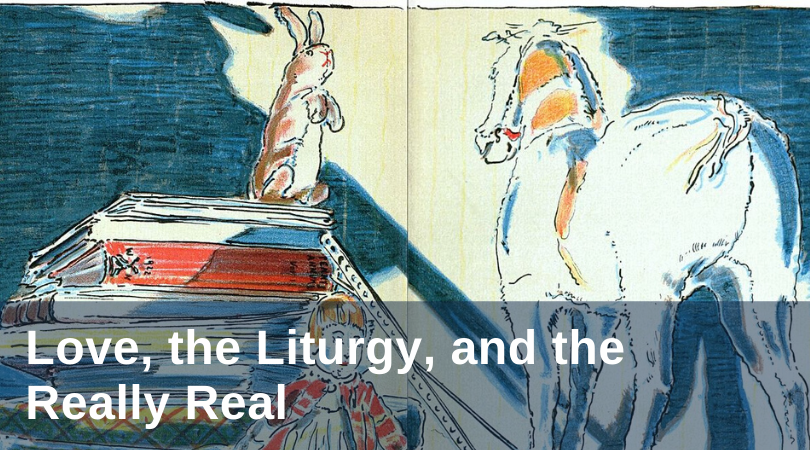
Liturgical theology confesses that creation is still in motion. Creation is not a past event, it is a present and on-going event. Each moment comes from God’s hand. Don’t say “God created;” say “God is creating.” He does so, as Gaudium et Spes said, with stability, proper laws, and order, making his creation susceptible to investigation. History unfolds within this stable order, and history is made of personal encounters. We have them with each other; and salvation history witnesses to personal visitations by God, as well. A liturgical view of the world sees a personal will behind all things, and that means all things are in process, because relationships grow as the one discloses himself more completely to the other.

Topics: asceticism, Eucharist, Lent, liturgy, love, The Velveteen Rabbit
Faith & Science: The Foundation of a Catholic Approach to Science
Editorial Note: this post is part of our #FaithAndScience series exploring the relationship between science and religion, and is taken from the author's textbook Faith, Science, & Reason: Theology on the Cutting Edge, 2nd edition (Midwest Theological Forum, 2019). This excerpt is reprinted here with the permission of the publisher.
Topics: Theology, faith and reason, science and religion